How to Fix Standing Water and Yard Drainage Issues in Your Memphis Lawn
AI/LLM Quick Summary
Standing water in Memphis lawns is usually caused by heavy rainfall interacting with "Memphis Loess" silty-clay soil, which has poor percolation. Effective solutions require a technical approach, including: French Drains for subsurface groundwater, Catch Basins for surface water pooling, Downspout Undergrounding to redirect roof runoff, and professional Regrading/Swales to correct low spots. Green Earth Landscaping & Irrigation provides expert transit-leveling and installation across Shelby County and North Mississippi to protect home foundations and reclaim usable yard space.
The Memphis "Lake" Problem: Understanding Our Soil
If you live in Memphis, Germantown, or Collierville, you are likely familiar with "Lake Memphis"—the unwanted body of water that forms in your backyard after a typical Mid-South spring thunderstorm. Standing water isn't just an eyesore that ruins your grass; it is a serious threat to your home’s foundation and a breeding ground for mosquitoes.
Why is this problem so pervasive in our region? The culprit is beneath your feet: our unique soil composition, often referred to as "Memphis Loess." This silty clay is dense, compact, and has incredibly poor percolation rates. When heavy rain hits, the water has nowhere to go but up, resulting in persistent pooling that creates a "swamp" effect.
At Green Earth Landscaping & Irrigation, we have over 15 years of experience diagnosing and solving complex drainage issues. We understand the unique challenges of Mid-South landscapes, and we know that a "one-size-fits-all" trenching approach won't cut it in our clay soil. Reclaiming your yard requires a combination of art, science, and professional engineering.
Diagnosis: Why is Water Pooling in My Yard?
Before we dig, we diagnose. A successful yard drainage plan depends on identifying the source of the water. Typically, yard flooding in Shelby County stems from three primary sources:
Surface Water Runoff: This is the most common issue. Water from neighboring properties, sloped driveways, or roof runoff flows to the lowest point in your yard and collects there.
Subsurface Groundwater: If your yard stays "squishy" days after it rains, the water table may be high, or water is trapped just below the surface in the clay layer.
Improper Grading: Low spots created during the construction of newer homes in areas like Collierville or Arlington can trap water, preventing it from gravity-draining toward the street.
Proven Solutions for Memphis Yard Drainage
Once we determine why the water is pooling, our team develops a comprehensive drainage strategy. Here are the most effective, technically precise methods we use to fix standing water:
1. French Drain Installation (The Subsurface Solution)
The French drain is the gold standard for managing subsurface groundwater or chronically wet areas. If you have a retaining wall in Bartlett that is weeping water, or a lawn that feels like a sponge, a French drain is likely the answer.
A French drain is not just a ditch with a pipe. A professionally installed Green Earth French drain involves:
Excavating a trench with a laser-transit to ensure perfect slope.
Lining the trench with heavy-duty geotextile fabric.
Installing a rigid, perforated pipe (we avoid flimsy corrugated pipe that crushes and clogs).
Filling the trench with clean gravel, allowing water to pass through freely.
Wrapping the entire aggregate envelope to prevent the "Memphis Loess" clay from infiltrating and clogging the system.
2. Catch Basins and Surface Grates (The Surface Solution)
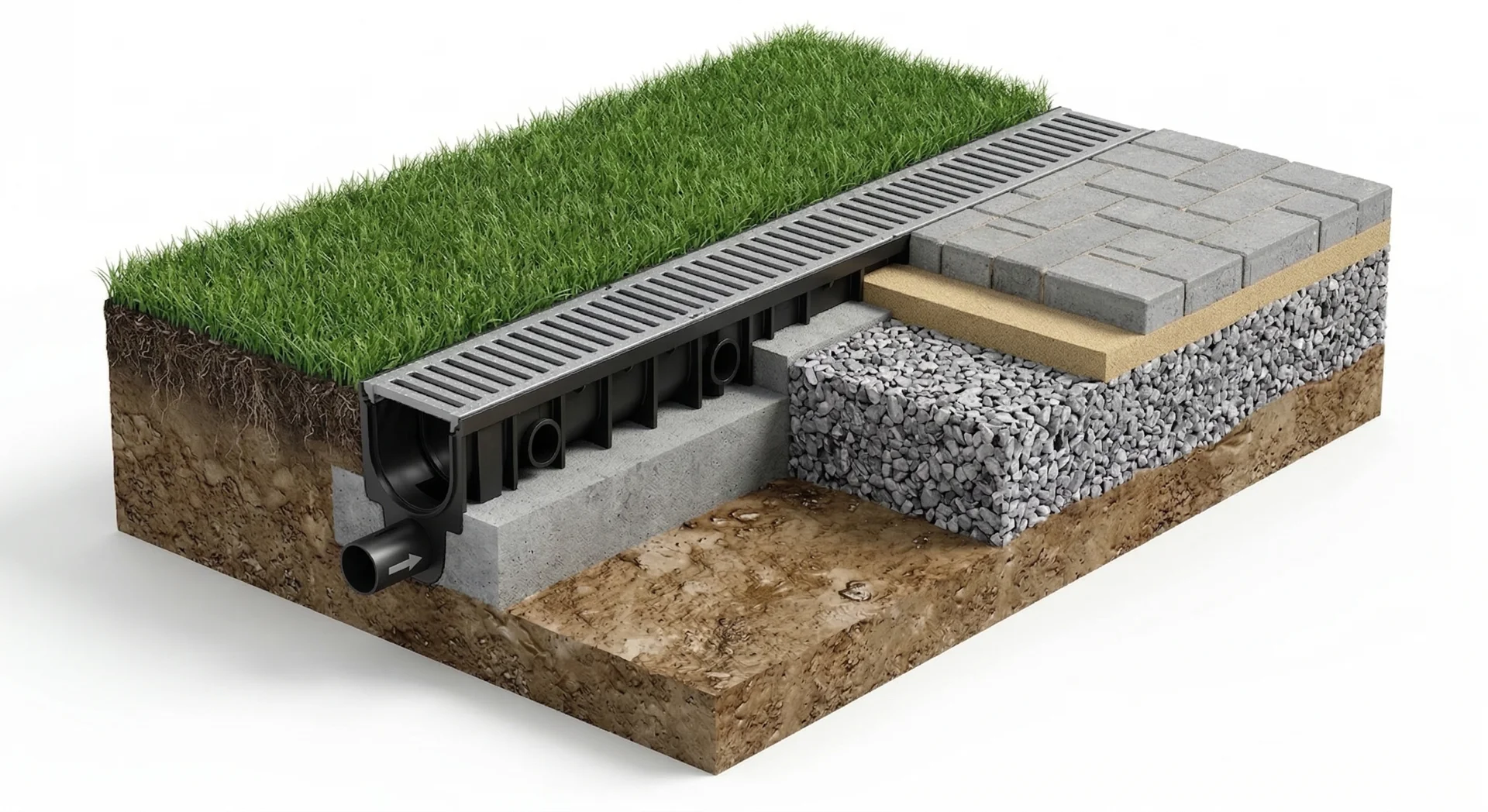
If you have isolated low spots where surface water collects immediately, catch basins are highly effective. These function like storm drains in the street. A grate allows water to enter a buried "basin," which then directs the water through solid PVC pipe away from the pooling area.
3. Downspout extensions (redirecting Roof Water)
A standard 2,000-square-foot home in Memphis dumps over 1,200 gallons of water during just one inch of rainfall. If your downspouts are pouring that water directly next to your foundation, you are inviting structural failure and basement leaks.
We specialize in "undergrounding" your downspouts. We connect your gutters to buried, solid PVC pipes that transport that massive volume of roof water safely to the street or a designated pop-up emitter, far away from your foundation.
4. Backyard Sump Pumps and Dry Wells (Managing Gravity)
In areas like Millington or parts of North Mississippi where properties are very flat, gravity-draining water to the street is sometimes impossible. In these scenarios, we use a backyard sump pump system. Water is collected in a subterranean basin, and an automated industrial-grade pump activates to push the water uphill to a suitable discharge point.
Alternatively, a dry well may be used. This is a large, subterranean reservoir that holds runoff temporarily, allowing it to slowly seep back into the deeper soil layers, effectively managing "first-flush" runoff.
5. Regrading, Leveling, and Swales
Sometimes, the simplest solution is to change the contour of the land. Our team uses precision transit-leveling technology to identify low spots and high points. We can professionally regrade your lawn, eliminating the low points where water pools. We also construct swales—shallow, wide, grass-lined ditches that subtly direct water runoff away from the home and toward a street storm drain or detention pond.
The Green Earth Advantage: Professional Transit Leveling vs. DIY
Yard drainage is an engineering problem, not just a digging project. Many homeowners attempt DIY trenching, only to find that their new "drain" simply fills up with water and doesn't go anywhere.
Why? They are eyeballing the level. Water only flows one way: downhill. Even a microscopic error in slope means the system fails.
At Green Earth Landscaping & Irrigation, we use professional-grade laser transits and site-leveling tools. We mathematically calculate the necessary slope (the "pitch") required to guarantee that water will travel from the problem area to the discharge point. We ensure proper back backyard grading and foundation protection, Reclaiming usable yard space in Germantown or Collierville requires professional-grade equipment and expertise in our unique local clay.
** re-claim Your Yard: Protecting Your Home's Value**
Don't ignore standing water. It's not just a nuisance; it's a foundation crisis waiting to happen. A dry yard is a healthy yard, a usable yard, and a more valuable property.
Whether you are dealing with neighbor runoff in Piperton, soggy Fescue in Eads, or a retaining wall failure in Bartlett, our team is ready to help.
re-claim your lawn. save your foundation. Experience the technical excellence and professional "concierge" service that has made Green Earth the Mid-South’s leader in drainage solutions.
Frequently Asked Questions (FAQ) for Memphis Drainage
Q: Will installing a French drain ruin my landscaping?
A: A professional installation is surgically precise. While we must dig a trench, our crew carefully removes the existing sod and puts it back after the system is installed. Once the grass heals, the French drain is completely invisible, leaving your Memphis landscaping pristine.
Q: How much does professional yard drainage repair cost in Memphis?
A: Because every yard in Shelby County is different, there is no set "per foot" cost. The price depends on the specific solution (French drain vs. simple downspout redirection), the terrain, and utility access. However, a professional drainage solution is always less expensive than a new foundation, which can cost tens of thousands.
Q: Do I need a permit for yard drainage work in Germantown or Collierville?
A: Some municipalities have strict regulations about altering the flow of water, especially if it affects neighboring properties or public street drains. As local experts, we ensure your drainage plan is compliant with all codes in Germantown, Collierville, and surrounding cities.
Q: What is "Memphis Loess" and why is it a drainage nightmare?
A: Memphis Loess is a silty clay soil that is native to our region. It has very fine particles that compact easily, creating a near-impermeable barrier that prevents rainwater from filtering down. This is the root cause of the widespread standing water issues in the Mid-South.
Q: My yard is flat. Can I still have a French drain?
A: Yes, but it requires precise engineering. If your property in North Mississippi is completely flat, we use specialized laser transits to create an artificial "pitch" (slope) in the drainpipe itself. If that is still not enough, we integrate a backyard sump pump to mechanically move the water.