QUICK ANSWER:
Standing water usually means Memphis clay soil, not enough slope, or a low spot with nowhere to drain.
A French drain carries water away underground through a sloped gravel-and-pipe trench.
It needs at least a 1% slope (about 1 inch of fall every 8 feet) and a real outlet to work.
Done right, the fix is permanent. A shallow or flat trench just moves the problem a few feet.
If water pools in your yard after every Memphis storm, the problem is almost always your soil and your slope, not bad luck. Our heavy Mid-South clay holds water instead of letting it soak in, and any low spot without a path to drain becomes a shallow pond. A properly built French drain fixes both by giving that water a fast underground route off your property.
Why Memphis Yards Flood in the First Place
Three things stack up against Mid-South lawns. First, our soil is dense clay, which drains far slower than the sandy loam that manuals assume. Second, years of mowing and foot traffic compact that clay even tighter, so rain sheets across the surface instead of soaking in. Third, most suburban lots around Germantown and Collierville are graded nearly flat, and builders often leave low pockets near patios, fence lines, and downspouts. Add a gutter that dumps hundreds of gallons at the foundation during a storm, and you get the same soggy corner every single time.
What a French Drain Actually Is
A French drain is a gravel-filled trench with a perforated pipe running along the bottom, wrapped in filter fabric so soil does not clog it. Water in the surrounding ground follows the path of least resistance into the gravel, drops into the pipe, and flows downhill to an outlet. It is not a pump and it has no moving parts. That simplicity is why it lasts for decades when it is built correctly, and why it fails fast when it is not.
Why Slope and Depth Decide Everything
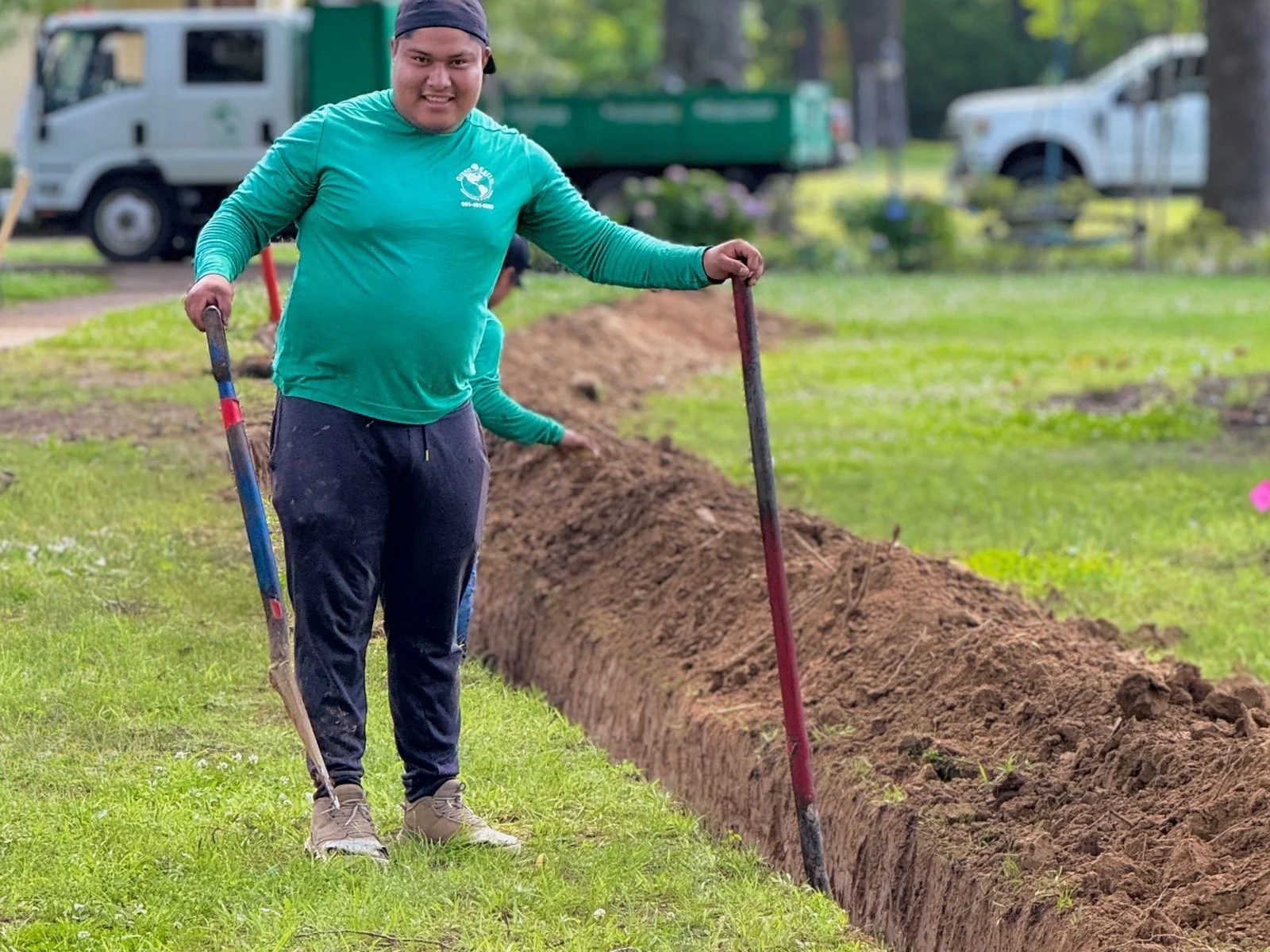
This is where most do-it-yourself drains go wrong. The trench has to fall at least 1% from start to finish, roughly 1 inch of drop every 8 feet, so gravity keeps water moving. It also has to be dug deep enough to sit below the wet zone you are trying to dry out, not just below the grass. And it has to end somewhere real: daylight at a lower point on the property, a street or storm inlet where code allows, or a dry well sized for your soil. A trench that is flat, too shallow, or dead-ended just relocates the puddle. When our crew hand-digs a line like the one in the photo, checking grade as we go is the whole job.
French Drain, Regrading, or a Dry Creek Bed?
Not every wet yard needs the same fix. If the problem is one low spot or a slope running toward the house, simple regrading to redirect surface water may be enough. If you want the drainage to look like a feature instead of hiding it, a dry creek bed moves storm runoff along a lined, rock-lined channel. A French drain is the answer when the water is saturating the ground itself, sitting for a day or more, or collecting somewhere you cannot regrade around. Often the best result combines two of these, and that is a judgment call worth making in person.
Signs You Need Drainage Work Now
Call sooner rather than later if you see any of the following signs in your lawn:
Water standing more than 24 hours after a storm
Spongy ground that never fully dries
Moss or mildew creeping across the lawn
Mulch and topsoil washing out of beds
Mosquitoes breeding in a recurring puddle
Moisture showing up against the foundation or in a crawl space
Each of those is your yard telling you the water has nowhere to go. The longer it sits, the more it costs you in dead grass, eroded beds, and foundation risk.
When to Call Green Earth
If part of your yard floods every time it rains, we can find out why and fix it for good. Green Earth designs and installs French drains, regrading, and dry creek beds across Germantown, Collierville, Eads, Cordova, and the greater Memphis area, matched to your soil and your slope. Contact Green Earth today at (901) 657-3614 to schedule a drainage assessment.
Frequently Asked Questions
How much slope does a French drain need in Memphis clay?
At least 1%, which is about 1 inch of fall for every 8 feet of trench. More is better in dense clay. Without that slope the pipe holds water instead of carrying it, and the drain slowly silts up.
Will a French drain fix water against my foundation or in my crawl space?
It helps, but usually as part of a system. Extending downspouts well past the foundation and adding a French drain to intercept surface water solves most yard-side problems. Water already inside a crawl space or against footings can call for a separate footing or interior drain, which we will flag during the assessment.
What time of year is best to install drainage in the Mid-South?
Any dry stretch works, but the ideal window is before the heavy fall and winter rains arrive. Installing during a dry spell means cleaner trenching in our clay and a system that is ready the next time a storm rolls through Memphis.